
As sustainability targets continue to reshape the plastics industry, BOPP (Biaxially Oriented Polypropylene) film recycling has become an increasingly important topic for film manufacturers, converters, and packaging producers worldwide.
BOPP film is widely used in food packaging, labels, tapes, and flexible packaging applications due to its excellent clarity, strength, and moisture resistance. However, the growing volume of production scrap, edge trims, startup waste, printed film, and off-spec rolls has created a significant challenge for manufacturers seeking to reduce waste and improve resource efficiency.
The Challenges of Recycling BOPP Film
Unlike rigid plastics, BOPP film presents several unique recycling challenges. The material has a very low bulk density, making it difficult to feed consistently into conventional extrusion systems. In addition, printed and metallized BOPP films may contain inks, coatings, moisture, and volatile residues that can negatively affect pellet quality if not properly removed. Industry experts also recognize that stable feeding, effective degassing, and high-performance filtration are critical factors in producing high-quality recycled PP pellets from BOPP film waste.
For many recycling operations, inefficient feeding and unstable extrusion remain the main obstacles to achieving consistent production output and pellet quality.
Why Compactor Type Pelletizing Lines Are Ideal for BOPP Film Recycling
To overcome these challenges, more recyclers and film manufacturers are adopting Compactor Type Pelletizing Lines specifically designed for film waste processing.
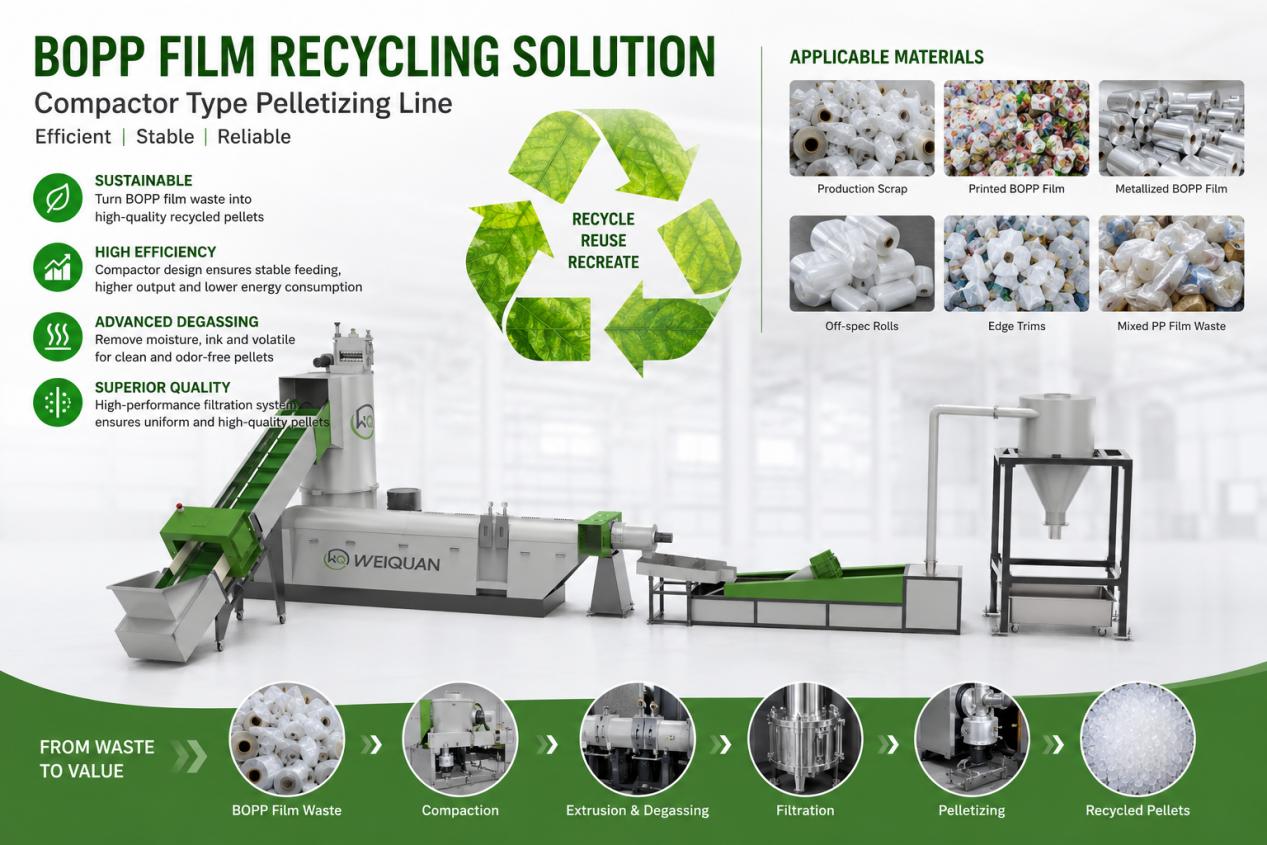
The integrated cutter compactor serves multiple functions simultaneously:
Size reduction of film scrap
Densification of lightweight materials
Pre-heating and drying through friction
Stable and continuous feeding into the extruder
This process significantly increases material bulk density and eliminates feeding fluctuations that commonly occur when processing BOPP film. Industry applications have demonstrated that compactor-fed systems improve material handling and provide more stable extrusion performance for lightweight film waste.
Advanced Degassing for Printed BOPP Films
Printed BOPP film recycling requires special attention to volatile removal. During the extrusion process, residual moisture, solvents, and printing ink components can generate gas and affect pellet quality.
Our Compactor Type Pelletizing Line is equipped with an advanced vacuum degassing system that efficiently removes moisture and volatile contaminants from the melt. Combined with a high-efficiency melt filtration system, the recycling line produces clean, dense, and uniform pellets suitable for downstream manufacturing applications.
This technology is particularly effective when processing:
Printed BOPP film
Metallized BOPP film
Production scrap and edge trims
Off-spec rolls
Mixed PP-based flexible film waste
High-Quality Recycled Pellets for Circular Manufacturing
With proper compaction, filtration, degassing, and pelletizing, recycled BOPP materials can be converted into high-quality PP pellets for various applications. Recycled pellets can be reused in injection molding, compounding, sheet extrusion, and other manufacturing processes, helping companies reduce raw material consumption and improve sustainability performance.
As circular economy initiatives continue to accelerate globally, investing in efficient BOPP film recycling technology is no longer just an environmental decision—it is also a smart business strategy.
Partner with Us for Your BOPP Recycling Project
Our Compactor Type Pelletizing Line is specifically engineered for recycling BOPP, OPP, CPP, PE film, printed film scrap, and other flexible plastic materials.
With stable feeding performance, advanced degassing technology, efficient filtration systems, and reliable pellet quality, we help plastic manufacturers transform production waste into valuable recycled resources while reducing disposal costs and improving operational efficiency.
If you are looking for a customized BOPP film recycling solution, contact our team today to discuss your material conditions, production capacity requirements, and recycling goals.
Post time: Jun-03-2026